


If you’ve ever walked down a bustling urban street in a city where small businesses rely on nimble, reliable transport, you’ve probably spotted a closed cabin cargo tricycle gliding past—quiet, maneuverable, and built for tasks that full-size delivery vans can’t handle. As a supplier of these specialized vehicles, I get asked all the time: “What makes those little three-wheelers so practical for work, especially in low light or bad weather?” Today, I’m breaking down one of the most underrated but critical parts of any of our Tricycle with Enclosed Cabin: its lighting system. This isn’t just a set of random bulbs strung on a frame—it’s a carefully engineered network designed for safety, compliance, and real-world utility for delivery drivers, small business owners, and logistics teams that rely on these vehicles day in and day out.
Let’s start with why the lighting system matters for a closed cabin cargo tricycle, specifically. Unlike open-tricycle models, the enclosed cabin of a Closed Cabin Cargo Tricycle protects the driver from rain, wind, and cold, but it also creates a smaller, more compact space where visibility is two-way: the driver needs to see the road ahead, and other road users (pedestrians, car drivers, cyclists) need to see the tricycle. For a vehicle that’s often used for last-mile delivery, moving through residential areas, side streets, and marketplaces where visibility is limited by parked cars or shopfronts, a faulty or inadequate lighting system isn’t just an inconvenience—it’s a safety hazard.
Our lighting systems are built to meet global transportation safety standards, but they’re also tailored to the unique needs of cargo tricycles, which are heavier than standard passenger trikes and often operate in crowded, low-speed areas where quick, clear communication between road users is key. Let’s break the system into its core components, so you can see exactly how each part works.
First, the front lighting array. This is what allows the driver to see the road at dusk, at night, or on overcast, foggy days. On all of our models, from the compact 5 Wheeler Cargo Tricycle with Cabin (popular for carrying bulk goods in tight markets) to the powerful 300cc Petrol Tricycle with Cabin designed for long hauls, the front lighting has three key parts: a high-beam headlight, a low-beam headlight, and daytime running lights (DRLs). The high-beam uses a bright, focused beam to illuminate the road 50 to 60 meters ahead—perfect for rural routes or quiet side streets with no streetlights. The low-beam is diffused, so it doesn’t blind oncoming drivers, which is essential for tricycles that might cross paths with cars or other vehicles in narrow spaces. DRLs, which are activated automatically when the tricycle is turned on, make the vehicle visible during the day, cutting down on accidents where other drivers might miss a small tricycle in traffic. For our Heavy Loading Tricycle with Cabin, we even add an auxiliary front fog light, mounted low on the bumper, to cut through heavy mist common in areas like Southeast Asia or mountainous regions where these trikes are widely used.
Next, the side marker lights and turn signals. These are often small, easy-to-overlook parts, but they’re critical for telling other road users what the tricycle is going to do. On the front fenders and side panels of the enclosed cabin, we mount bright amber side marker lights that are visible from the front, side, and back. These are mandatory in most regions because they make the tricycle’s profile clear, even when it’s parked at the side of the road or moving slowly through traffic. The turn signals—both front and rear, on each side—are high-intensity LEDs, which last longer than incandescent bulbs and are brighter in sunlight. For drivers who often need to make wide turns when carrying heavy cargo, like building materials or large boxes, clear turn signals prevent confusion and reduce the risk of collisions. We also add a side mirror with a built-in indicator light on newer models, a small upgrade that makes a big difference in busy intersections.
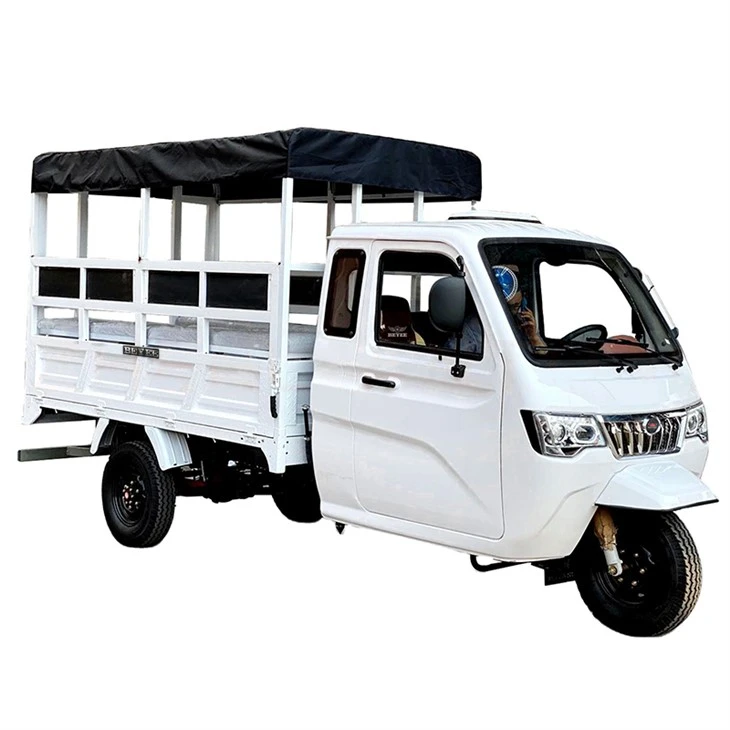

Then there’s the rear lighting system, arguably the most important part for safety. The rear needs to be visible from 100 meters away, even in rain or dark. The main rear light is a combination tail light, brake light, and reverse light—all in one compact unit mounted high on the back of the cargo cabin. The tail light is a low, steady red light that’s on whenever the tricycle is running, marking its presence. The brake light is much brighter, activating automatically when the driver hits the brakes, so drivers behind can see when the tricycle is slowing down. The reverse light is a bright white light that illuminates the area behind the tricycle, which is essential for drivers who often need to back up into tight delivery spots, like loading docks or alleyways. We also add rear reflectors—plastic or metal panels that reflect light from other cars’ headlights, even if the power is off. These are non-negotiable for compliance in markets around the world, and they’re a cheap, reliable safety feature that’s saved more than a few drivers from being hit at night.
Now, let’s talk about how the entire system is powered and controlled, because that’s where a lot of cheaper, less reliable tricycles cut corners. Our closed cabin cargo tricycles use a 12-volt DC electrical system, which is matched to both electric and petrol models (like the 300cc petrol version). The lighting system is wired directly to the tricycle’s battery, with a dedicated fuse for each component—this prevents a single faulty bulb from taking out the entire system, a common problem on budget trikes. The control panel, located on the dashboard inside the enclosed cabin, has simple, intuitive switches: one for headlights (off, parking, low, high), one for turn signals, and a separate switch for fog lights and hazard lights (which flash all turn signals at once, perfect for when the tricycle is parked on the side of the road for loading or unloading). We design the switches to be big and easy to use, even if a driver is wearing work gloves—no tiny, hard-to-press buttons here, because when you’re making deliveries in the rain, you don’t have time to fumble with controls.
One of the biggest advantages of our lighting systems, especially for enclosed cabin models, is that they’re sealed. The cabin is built to keep out water and dust, and the lighting components follow the same rule. We use IP67-rated lights, which means they’re completely dust-tight and can be submerged in up to a meter of water for 30 minutes. That’s a huge deal for drivers working in monsoon seasons, or in dusty construction zones where debris could get into the bulbs. On older tricycles with exposed lighting, water damage is the number one cause of lighting failures—no one wants their brake light to stop working in the middle of a busy street. We also use LED bulbs for all the main lighting components, which have a lifespan of up to 50,000 hours—way longer than traditional incandescent bulbs, which need to be replaced every 1,000 hours or so. For a driver who uses their tricycle 8 hours a day, 6 days a week, that’s years without replacing a bulb, which saves time and money.
We also design the lighting system with real-world driving conditions in mind. For example, in many markets, closed cabin cargo tricycles are used to transport perishable goods—like fresh produce, flowers, or baked goods—so they might be on the road at 4 a.m. before the sun comes up, making their first deliveries. Our lighting systems are engineered to have consistent brightness in cold weather, so drivers don’t have to worry about dimming headlights when temperatures drop at dawn. For electric models, which are growing in popularity for their low operating costs, the lighting system is optimized to draw minimal power, so it doesn’t drain the battery faster than necessary. We test every lighting setup in extreme conditions: we take trikes to fog chambers to test visibility in dense mist, to cold storage facilities to test bulb performance in freezing temperatures, and to dusty construction sites to make sure the lights don’t get clogged or fail.
I’ve seen first-hand how a good lighting system makes a difference for drivers. A few months ago, we worked with a small delivery company in Jakarta that was using budget open trikes, and they were having 2-3 minor accidents a month because other drivers couldn’t see them in the dark. They upgraded to our closed cabin model with the full lighting array, and after three months, they had zero accidents related to visibility. The drivers told us they felt much safer, especially when making left turns across busy roads, because other cars could see their turn signals clearly. That’s the kind of real impact that a well-designed lighting system has—it’s not just a set of parts, it’s a tool that keeps people safe and their businesses running.
If you’re in the market for a closed cabin cargo tricycle, whether for last-mile delivery, construction, agriculture, or any other use, the lighting system is one of the key things to look for. A lot of suppliers will cut corners on lighting to lower the price, using cheap bulbs that burn out quickly or lights that aren’t visible enough. But at the end of the day, a tricycle is only as good as its ability to get you and your cargo from point A to point B safely. Our range includes options for every need: from the compact 5-wheeler perfect for urban markets to the heavy-loading model for long hauls, all with lighting systems built to meet global safety standards and designed for the demands of daily work.
If you’re ready to learn more about our closed cabin cargo tricycles and how their lighting systems (and other features) can fit your business, we’d love to connect. Whether you’re a small business owner looking for your first delivery vehicle, or a logistics company needing to upgrade your fleet, we can provide detailed specs, test data, and pricing to help you make the right choice. Get in touch with us today to start the conversation about finding the right tricycle for your needs.
References
- National Highway Traffic Safety Administration (NHTSA). "Motorcycle and Low-Speed Vehicle Lighting Requirements." U.S. Department of Transportation, 2022.
- International Organization for Standardization (ISO). "ISO 6722:2019, Road vehicles – Light bulbs – Performance requirements." ISO, 2019.
- Asian Development Bank (ADB). "Sustainable Cargo Transport: Tricycles for Last-Mile Logistics in Southeast Asia." ADB Transport Sector Paper, 2021.
- International Electrotechnical Commission (IEC). "IEC 60529:2017, Degrees of protection provided by enclosures (IP code)." IEC, 2017.
- World Health Organization (WHO). "Road Safety: Vulnerable Road Users." WHO Global Status Report on Road Safety, 2023.